
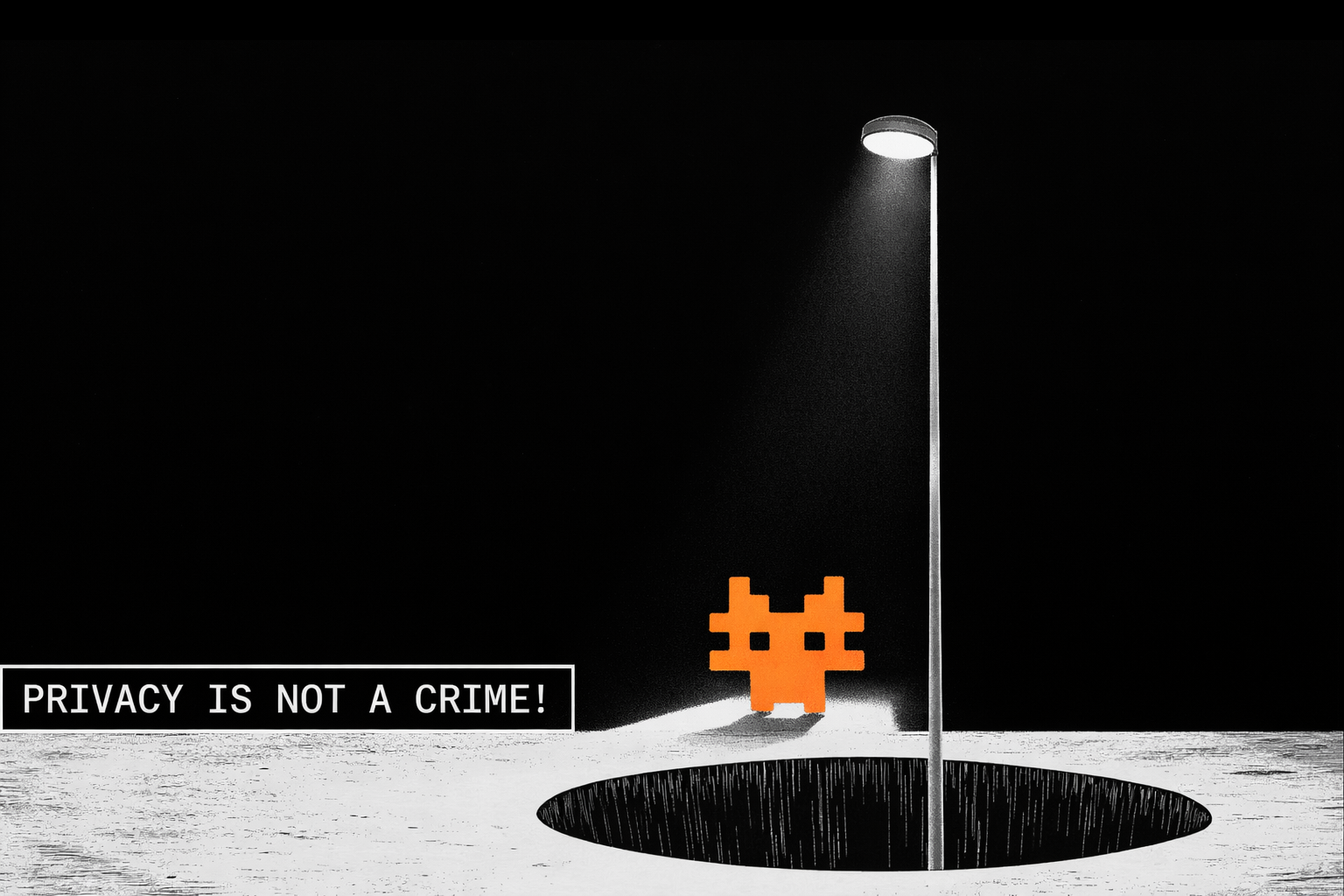
Privacy 101
Introduction to Web3 privacy: why it matters, how tracking works, and the basics of privacy-preserving tools.
What Is Privacy?
Who’s Watching Us: Why Privacy Matters

“Privacy is the power to selectively reveal oneself to the world.” — Eric Hughes
Privacy is a fundamental human right. It is woven into national constitutions, reinforced by law, and inseparable from human dignity, autonomy, and freedom. Yet in the digital age, privacy has quietly eroded. Every click, message, transaction, and interaction leaves a trail. Surveillance is no longer exceptional—it is ambient.
Privacy is not merely about hiding wrongdoing. It shapes how people think, speak, organize, and dissent. When individuals believe they are being watched, behavior changes. Creativity narrows. Risk-taking fades. Power concentrates.
Privacy breaches are therefore not just personal violations; they are societal failures. They reshape incentives, redistribute power, and quietly redefine what freedom means in practice.
The Significance of Privacy in Web3

“Crypto is currently the only solution that combines the benefits of digitalisation with cash-like respect for personal privacy.” — Vitalik Buterin
The internet we use today—often referred to as Web2—was built on centralized data ownership. Large corporations collect, store, analyze, and monetize user data at massive scale. Individuals have little visibility into how their information is used, and even less ability to control it.
A 2023 Pew Research report found that more than 80% of American adults feel they have little to no control over how the government or private companies collect and use their data. Identity theft, invasive tracking, and data breaches have become routine.
Web3 emerged as a response to this imbalance. Rather than concentrating power in platforms, Web3 proposes decentralized infrastructure where users own assets, identities, and data directly. Privacy is not an afterthought—it is embedded into the architecture. But whether Web3 truly delivers on this promise is still an open question.
A Brief History of Blockchain and Privacy

Web2’s defining flaw is data centralization. Companies like Google, Facebook, and Apple store vast quantities of personal data in centralized repositories. Users cannot audit how their data is handled and must trust institutions whose incentives often conflict with user welfare.
Web3 attempts to invert this model. Built on blockchains, cryptography, and peer-to-peer networks, it removes the need for centralized intermediaries. Trust is replaced by verification. Control shifts from institutions to individuals. Decentralized identity systems, user-owned storage, and permissionless protocols enable people to interact, transact, and coordinate without surrendering personal information.
How Web3 Changes the Privacy Landscape

Decentralized identity and self-sovereignty
Web3 enables decentralized identifiers (DIDs), allowing individuals to prove attributes about themselves without revealing full identities. Instead of logging in through centralized identity providers, users control their credentials directly. Technologies like zero-knowledge proofs allow someone to prove they are eligible, verified, or compliant—without disclosing unnecessary personal data.
Protecting personal data
Smart contracts allow users to prove ownership of assets without exposing private information. Techniques such as secure multi-party computation, differential privacy, and decentralized storage networks enable collaborative computation and data storage while keeping raw inputs private and out of centralized silos.
Privacy-preserving protocols
Web3 integrates privacy-first primitives such as zero-knowledge proofs, ring signatures, homomorphic encryption, and confidential transactions. Payment protocols and privacy-focused blockchains further reduce metadata leakage while maintaining verifiability.
The Challenges Facing Web3 Privacy
Despite its promise, Web3 is not immune to risks. Regulatory uncertainty remains a major challenge, with fragmented and sometimes conflicting rules across jurisdictions. Compliance pressures can unintentionally reintroduce surveillance through mandatory identity checks and data retention.
Technical challenges persist as well. Public blockchains can leak metadata. IP-based networking allows adversaries to correlate wallet addresses with physical locations. Smaller private networks may be more vulnerable to attacks due to limited validator participation. Privacy is not automatic; it must be intentionally designed, defended, and used correctly.
From Cypherpunks to the Trustless Web

Long before Web3, cypherpunks argued that cryptography was essential for preserving privacy, free speech, and autonomy in a networked world. Their manifesto framed privacy as the power to selectively reveal oneself—not secrecy, but control. Anonymous transactions and open-source code were tools for defending civil liberties against state and corporate overreach.
Bitcoin and later Ethereum turned these ideas into working networks. Bitcoin minimized trust in intermediaries; Ethereum extended that model to programmable coordination. Both reflect cypherpunk principles of openness, permissionlessness, and censorship resistance—but those values require constant reinforcement in how we design and govern new systems.
Why Cryptocurrency Needs Privacy
Balancing transparency and anonymity in the crypto space.
Public blockchains make every transaction globally visible. This radical transparency builds trust, but it can also expose sensitive financial behavior. Wallet histories can be traced, relationships inferred, and entire portfolios profiled—often from just a few leaked identity clues.
Privacy features in cryptocurrency aim to restore a cash-like level of discretion while keeping the benefits of verifiable ledgers. The goal is not secrecy for its own sake, but protection against data misuse, coercion, and pervasive surveillance.
How Cryptocurrency Promotes Privacy
Different tools address different parts of the privacy problem. Privacy coins, mixing techniques, and zero-knowledge-based systems reduce how much information on-chain observers can learn about who paid whom, for what, and how much—while still allowing the network to verify that rules are being followed.
- Transparency creates trust by exposing invalid behavior and fraud.
- Privacy protects individuals from profiling, targeting, and financial surveillance.
- The real challenge is finding architectures that give regulators enough signal to act on genuine abuse without turning every user into a permanent subject of financial tracking.
Privacy, Transparency, and the Crypto Paradox

Blockchains are radically transparent: every transaction is publicly verifiable. This transparency creates trust, prevents fraud, and enables accountability—but it also exposes behavior patterns, relationships, and vulnerabilities. Pseudonymity is fragile once addresses are linked to real-world identities.
The challenge is not choosing between privacy and transparency, but balancing them. Privacy coins, confidential transactions, layer-2 networks, off-chain computation, and selective-disclosure proofs are all attempts to strike that balance while keeping systems auditable.
Where Privacy Goes From Here

Regulators, builders, and users are still negotiating what responsible privacy looks like. Heavy-handed rules risk centralizing power and undermining civil liberties; total absence of oversight invites abuse. The likely path forward is selective transparency—systems that allow lawful accountability without exposing everyone by default.
Technology alone is not enough. Culture, incentives, and narratives matter. The next phase of privacy will be built by diverse communities of developers, designers, activists, educators, and policymakers who make privacy tools usable, understandable, and worth caring about.
- Privacy is a prerequisite for real autonomy, not an optional add-on.
- Web3 gives us new tools, but they only work if we use and govern them wisely.
- The balance between transparency and privacy will define whether crypto reinforces surveillance—or helps escape it.